Thursday, August 12, 2010

"Today ripped jeans, fraying shirts and laddered stockings stand in metaphorically for a disintegrating social climate"

Some prophetic words from the Parson's students in this article, and more observations on their blog

I'd comment, but I am so on-par with their observations, for once...I've got nothing to add here.

Or I'm just getting lazy.

An original favorite (ok, original revival)...from Rodarte Fall/Winter 2008.

Tuesday, August 10, 2010

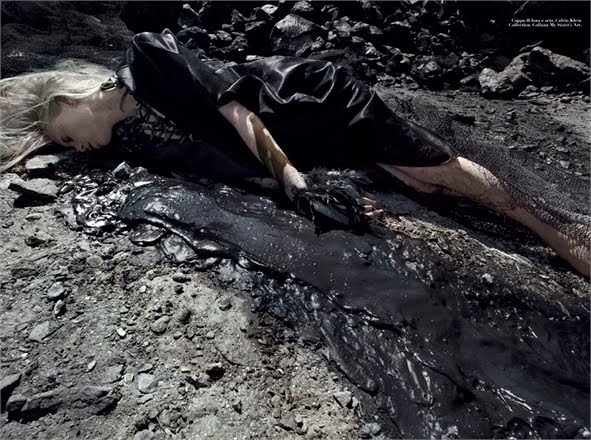
Vogue Italia...Dying for Sales?

 
The greatest magazine promo just went down at Vogue Italia for the August 2010 issue. 

Newsstand numbers low? No problem. Just drown Kristen McMenamy in faux industrial waste and let Steven Meisel go to town.

The photos are beautiful...but bizarre and in my opinion tasteless, but hey, August is never a high-grossing month for magazines so they had to do something!

My favorite part of this whole thing is the caption: 

Kristen McMenamy in the "survivor" version, where she interprets in images the environmental drama that's afflicting the Gulf of Mexico. She keeps her skin golden thanks to Self Tan Face Bronzing Gel Tint (to wear alone or with foundation): it takes care of the skin, while giving it a hint of color.
Photo credit: Vogue Italia, August 2010

Wednesday, June 23, 2010

A note to Alexander Wang

I will preface the note below by mentioning that every day I see  beautiful vintage pieces of clothing, jewelry and accessories as a part of my job. I get paid to work in a very, very, very big closet. And I love it.

And, I often see things that I think certain designers should immediately buy and use for their own work. Sometimes a textile, a belt, a necklace, etc., calls to me and I answer.

Today I am writing to Alexander Wang to I release some of my inner inspiration (angst?).

Dear Mr. Wang,

I have never met you, though it is not  too crazy to think that perhaps our paths will one day cross. 

I have just unwrapped several Whiting & Davis mesh handbags that are probably more than 100 years old. The metal is worn, but not rusty, and the delicately broken down fibers are cool to the touch. In short, they are beautiful and amazing and just holding them in all their splendor sends a shiver down my spine. (Who once used this little purse to attend Victorian-era society parties? I ask myself.)


But I digress.

Since you're so set in your minimalistic ways, I'd like to propose the introduction of vintage W&D mesh into your next collection. Think: tanks, lined shorts, harem pants? Sasha Pivavarova and Aggy Deyn would rock that shit.


Thank you for taking the time to read my thoughts. 

xoxo
Jen

Summer Solstice, hath returneth to the blog

I am going to pretend that I stopped blogging for so long because I was so dejected about Alexander McQueen's suicide, which caused my hope for the future of fashion innovation to completely cease (not too far from the truth). 

With Sarah Burton now as McQueen's creative director and Pina Ferlisi as the CD at McQ, my faith is slowly but surely being restored. 

And, well, I just missed writing about this shit so I'm going to make time again.

For your viewing pleasure, a diagram of Pina Ferlisi's career to the present. Courtesy of me.

Friday, February 12, 2010

Mourning McQueen: A Senseless Suicide

At the risk of sounding like another whiny platform-clad fashion student at the NYFW tents...I must admit I'm devastated by the news of Alexander McQueen's suicide.

His designs set the tone for fashion since the early nineties...it's sad to think the young designer's inspirational force will never again affect the global aesthetic.

But, instead of writing another obit commemorating the iconoclastic Brit (I did this already for Slant yesterday...), I'm just going to rip some photos that instill pleasant memories of McQueen's visionionary and pervasive influence...


McQueen & Isabella Blow, Vanity Fair March 1997


McQueen's “Oyster Dress,” from Spring/Summer 2003. Ivory silk chiffon and silk organza.

From his Spring/Summer 2008 collection, in honor of Issy Blow after her suicide in May 2007.


The infamouse Armadillo shoes from Spring 2010.

Theatrical gothic at the Fall 2009 runway show.

A brighter vision in Spring 2008.

Out of this world...Spring 2010's Avatar-inspired collection.


Alexander McQueen...1969-2010. You will be missed.

Monday, January 4, 2010

GALLANT STRIDES: Galliano Through the Lens

Hello, 2010!

There's no better way to start the new year than by celebrating a living legend -- and one with whom I was lucky enough to spend some time this past year, Mr. John Galliano.

He's got a lot going on in 2010; launching Galliano, his menswear collection, his role at the helm of Christian Dior (going on his 15th year as lead designer), and the continuation of his visionary namesake label.

Tracking the ongoing success of a the designer, photographer Mark Leibowitz took a backstage look at the John Galliano ready-to-wear shows for fall 2008 and spring 2009. The images are stunning, and so thoroughly depict the mayhem that's typically hidden from the lens.

If nothing else, they're absolutely an inspirational way to start the new year...


And now you can take Galliano home with you, too. Photographer Roxanne Lowit just published Backstage Dior, a compilation of shots she's amassed from backstage access to the runways at Christian Dior throughout the last 10 years. There's nothing quite like a book of flashbulbs and haute couture to bring in a new decade. Bonne Année!

Photo credit: Backstage at the John Galliano exhibition; photographs by Mark Leibowitz.

Thursday, December 31, 2009

WINTER WONDERLAND: Bye, Bye 2009!

Brooklyn is beautiful this morning. Walking to work is rarely an enjoyable experience, especially in the winter time. But today, the last day of 2009, dime-sized snowflakes are falling, turning the loading docks into mini-wonderlands...and it's making me incredibly nostalgic.

Here are some gorgeous photos taken for Numéro Magazine last year.

The ethereal beauty of this silk is the perfect compliment to the soft snow falling outside my window...


Photo credit: Numéro 91, March 2008.

Wednesday, December 30, 2009

ELSA SCHIAPARELLI: No Bones About It


Lindsay Lohan is expanding her formerly leggings-only label 6126 into a full force line of contemporary apparel come Fall 2010.

Happy as I may be for 'ol LiLo, this got me thinking about the downfall of artistic development in the fashion industry. With celebrities launching clothing and accessories lines left and right, the concept of fashion design seems to be withering away. 

Still in reflection mode ahead of New Year's Eve, my mind is focused today on the positive: one of the most artistically inclined designers in history, Signora Elsa Schiaparelli.

Schiaparelli was a fabric architect; a true creator of style. And, more so than most designers can claim today, she was in touch with a world of talented artists, and brought their work to the forefront as a result of her own success.

Taking cues from Pablo Picasso and George Braque, as well as collaborating with the likes of Salvador Dali, Jean Cocteau, Leonor Fini and Alberto Giacometti, she pushed boundaries, forced a reconsideration of lines and proportions and pioneered the concept of wearable art.

Here's a look at my favorite piece from Schiap, the Skeleton Dress she created with Dali as part of the Circus Collection in 1938, once again blurring the definition of 'beauty'.


Photo credit: Victoria & Albert Museum, Textiles & Fashion Collection, from the exhibition: "Fashion: An Anthology by Cecil Beaton."

Monday, December 28, 2009

Follow my blog with bloglovin

GRUNGE REVISITED: Marc Jacobs Eat Your Heart Out

With the new year in sight, the most natural reaction (and easiest blog post) is to reflect on times past.

Fashionably speaking, reviewing the last year is like watching an episode of "My So-Called Life."

To the dismay of many, this tribute has nothing to do with Claire Danes and Jared Leto, but rather the re-invasion of Kurt Cobain-inspired haircuts (or lack thereof); beard growth to rival ZZ Top; and enough threadbare flannel to outfit an army of lumberjacks in Southwest Oregon.

Today, I'm honoring my favorite symbols of 90's grunge; the poster children that Marc Jacobs for after his 1992 collection for Perry Ellis: Kate Moss & Johnny Depp.

Enjoy...


Monday, November 30, 2009

TALK IS CHEAP: Designer Diffusion, Part III

An important message to designers: Stop making cheap clothes.

Allow me to clarify. I am not, nor have I ever been against the production of moderately priced high-fashion. I can appreciate the novelty of Manolo for Payless as much as the next girl, and yes, I'd line up 'round the block at 4 a.m. to get a first look, too. But honestly, I'm not buying that crap.
With names like Jean-Paul Gaultier and Jimmy Choo diving into mass market design, I have to ask: Where does it stop?

I know times are tough and Bergdorf's isn't buying the same way they used to, but can some of these design houses please hold out and hold on to their brand image? Make a few bucks at a discount retailer this year, and next year top tier clients at Sak's and Neiman's aren't going to look twice. Know why? Because the stuff at Target and H&M is shite.
Yes, it's exciting to have bought a new Luella Bartley jacket, but if it costs $30, chances are, it's falling apart in two months. The point of high fashion is quality, and in a recession like the one we're sinking deeper into, it would seem to me that focusing on durability in both manufacturing and style would get the job done much more effectively than selling hoards of mass produced $20 t-shirts in a store where I can also purchase tampons and cereal.

Sonia Rykiel, Zac Posen, Anna Sui...you've hurt me enough. But now the Mulleavy sisters - whose work I've loved since they hit the scene with a collection of just 10 pieces in 2005 - are also hitting up the big red bull's eye this Sunday.

Alas...I guess I'll have to see what all the fuss is about.

Photo credit: Rodarte's first advertisement; Spring 2009.

Tuesday, November 24, 2009

PUSHING PRADA: If the Devil Reads It, Then I Do, Too.


When the Devil wore Prada, heads turned, books sold and movies were made. Just ask Anne Hathaway how influential Miuccia has been to the world.

The Prada book 708 glossy pages stuffed with 3,885 thumbnail images of runway looks; ad campaigns spanning more than 20 years; each and every store and every design made by Ms. Prada since 1988; plus collection design details, including background on concept, production and materials – looks like a thick piece of heaven.

Just in time to not save money this Black Friday, I think heading to the Prada store in SoHo to purchase this $125 confection seems like a worthy cause. The two other monstrous coffee table tomes due out this year, from Louis Vuitton and Maison Martin Margiela, just don’t have the same cache for me.

Photo credit: Prada promotional material.


Thursday, October 8, 2009

CAPPING THE LENS: Irving Penn Dies

Yesterday, Irving Penn died.

He was 92 years old, and had been working in fashion since the summer of 1937, when he began as an unpaid design assistant for Alexey Brodovitch at Harper’s Bazaar. Only three years later, Penn inherited Brodovitch’s position as director of advertising design for Saks Fifth Avenue.

Of course, we know Penn best through his work with Vogue – spanning some 66 years – as well as through the cumulative star power generated by his 42-year marriage to Lisa Fonssagrives, the Swedish-born model with whom he sculpted the world of fashion photography in the 1940s and 50s. Fonssagrives died in New York at age 80, in 1992.

About fifty years prior, in 1943, Penn met the man who would one day herald the young photographer as his protégé – then editorial director of Conde Nast Publications, Alexander Liberman.

Liberman helped cultivate the style for which Penn became famous. It was the starkly lit, glowingly austere prints and renowned technical skill that earned him recognition as one of the most artistic photographers of his time. Penn’s work “bridged the gap between commercial photography and fine art…he revolutionized the way fashion was presented to a mass audience,” writes Women’s Wear Daily.

Following the death of his longtime contemporary, Richard Avedon, in 2004, the death of Irving Penn is decidedly sad. It marks the end of an era, and pushes to the forefront a greater need for current photographers – think Annie Leibovitz, Mario Testino, Helmut Newton, Corinne Day and David LaChapelle – to mold their images for the world; not just for fashion, but for humanity, the way both Penn and Avedon sought to do. As the saying goes…a picture is worth 1,000 words.

Photo credit: Entitled "Café in Lima," Irving Penn photographs Jean Patchett for Vogue, February 15, 1949.

Thursday, October 1, 2009

COLD SHOULDER: Deciphering the Pad

If a rise in hemlines indicates the recession’s end, then how do we decode the return of the shoulder pad?

To the chagrin of some and the joy of many, our necks will be in good company this year if the blazers shown for spring 2009 get any play. It seems that, following the resurgence of strong shoulders last year and popularized by Christophe Decarnin for Balmain, this once-feared bastion of the 1980’s will be a seasonal mainstay once again.

Theorizing the sociological implication of strong shoulders (so what if I’m pretentious about fashion?), Ann Marie Hourihane of the Irish Times writes: “…sad to say, the shoulder pad has frequently been accessorized by the dole queue. The shoulder pad is a symptom of a culture’s willingness to work when work is scarce. The shoulder pad, when worn by women, signals fortitude in times of distress.”

Ms. Hourihane’s UK neighbor, Janice Turner of the London Times, takes it a step further: “Perhaps women clinging to their jobs are striving harder than ever to assert their power — shoulder pads too are back in town.”

So then, are reports calling an end to the recession completely moot? Skirts are getting shorter and shoulders are rising higher; but the translation of those observations into economic-speak presents a complete contradiction. Maybe the reemergence of shoulder pads is a mere indication that women are wising up to the fantastic contributions prominent shoulders can make to the female shape.

Betsey Johnson told Emili Vesilind of the LA Times that fashion's '80s redux makes perfect sense because "when times are threatening, they always inspire creativity." And in her estimation, "It's actually the first time anything creative [in fashion] has happened since the '80s. It feels the same now as it did then."

Betsey might be on to something. Let’s just hope creativity can pull us out of this slump and keep the pads, puffs and pagoda sleeves a comin’.


Photo credit: Harper's Bazaar UK, February 2009; Model Zuzana Gregorova.

Tuesday, September 29, 2009

IN THE RED: Annie Leibovitz Gets to Work

Renowned photographer Annie Leibovitz, who just recently staved off near financial ruin by postponing the collection of her outstanding $24 million loan, is still seeing red.

But this time, the color has a more positive association – that is, contributions to the Red Cross in the form of bespoke leather goods.

Leibovitz, along with five other artistic icons, is
guest designing leatherwear to be assembled by Louis Vuitton's master craftsmen at its Asnieres workshop near Paris, which will then be sold at a Sotheby’s auction in London on November 17th, with proceeds benefiting the scarlet charity as it commemorates 150 years of global goodwill.

Having shot the likes of Sofia and Francis Ford Coppola for Vuitton's “core values” campaign, Leibovitz is familiar with spreading goodwill on an international scale – remember the
Demi Moore-nearly nude-pregancy shot? That was groundbreaking. How could we as a society have possibly functioned without the decades of unclothed celebrity mommies-to-be that followed? (I’m only being half sarcastic here.)

The slightly androgynous photographer stayed true to her utilitarian roots when designing for LV. She requested a spacious backpack – no handbags here, ladies – to accommodate personal effects and photo equipment, while leaving her hands free. The monogram canvas sack is trimmed in black leather and lined with red, cushioned microfiber compartments, and it doesn’t stand alone. With her own extensive photographic paraphernalia in mind, Lebovitz’s design includes a matching rectangular shoulder camera bag, with external zippered compartments for accessories.

The
other contributing designers are just as varied and unique as Leibovitz herself: There’s animal installation artist Damien Hurst, Oscar-winning composer Gustavo Santaolalla, Spanish chef Ferran Adrià, LV’s head of special orders Patrick-Louis Vuitton (also a fifth-generation family member), plus LV creative director Marc Jacobs.

While I’m happy to encourage the charitable spirit, I do wish Ms. Leibovitz would do some income-generating work so we don’t soon find her hustling chop-shop photos for
NYC tourists in Central Park…

Photo credit: Louis Vuitton advertisement, July 2008.

Friday, September 4, 2009

THE GREAT DEBATE: Is Fashion Art?


Each morning, in preparation for daily life, we get dressed. Well, hopefully, anyway. For some, there is no philosophy behind the day-to-day ensemble; it is merely a reflection of practicality, affordability and climate. For others, however, dressing is an expression of their inner self. Clothing can be used to evoke feelings, inspire sensations and garner reactions.

In considering the possibility that there is a large population identifiable with the former (and surely not reading this blog post), questions abound: What is fashion, and what should it be? A practical warping of fabric for function? A pretentious, self-indulgent industry swimming in false importance? Or, as I prefer to think, is it merely an aesthetic representation of the time in which we live? And, for that matter, can fashion be all of these things at once?

Whether you’re of the mind that Rei Kawakubo is a genius or a quack – or you think that’s some sort of Japanese noodle dish – there is one element that can surely bridge this distinct divide. That is, the element of history. Fashion, like art, can often form a basis for historical reference. The clothing of a given era reveals many things about its wearers. Who wore what where? How much money did they have? What do they do for a living? What did they do for fun? What were their political leanings? What music did they listen to? The list goes on.

One of the most validating trips I’ve taken of late was to the Fashion & Politics exhibit at the FIT Museum, which completely justified my regular psychoanalytical fashion babble. The showcase, “a chronological exploration of over 200 years of politics as expressed through fashion…not only refers to the maneuverings of government, but also encompasses cultural change, sexual codes, and social progress.”

Despite the museum’s no-photo policy, my gorgeous friend Tom brought a bit of the exhibit back for you, via his stunning fashion illustration skills. Check-out his handiwork above – proof at the very least that to create fashion, one must appreciate art.

Wednesday, August 5, 2009

I’LL RACE YOU: Let’s Talk About Black Baby

Naomi Sims made fashion history. She was the first black model to appear on the cover of a mainstream women's magazine, Ladies' Home Journal in 1968. Then the cover of Life in 1969. The announcement of her death this morning, at the premature age of 61, was undoubtedly sad.

But I’m not one for morose musings, and I’m certainly not one to call a pig a cow. Before you immediately assume that I’m heartless and completely void of emotion, allow me to elaborate…

Often, when people die, we (family, friends, media, etc.) tend to romanticize their time on earth. We make them out to be better people than they were; embellish their accomplishments; inflate their level of influence; ignore their faults; forgive their sins; the list goes on. And, while I can jump on the bandwagon and commend Sims for her infiltration of the mass media and the magnanimous power she wielded over the "Black is Beautiful" movement in the 1960’s, what I’d really like to contest here is how far we as a society have come in our recognition and acceptance of multicultural beauty.

Sims certainly laid down the red carpet for future superstars – Pat Cleveland, Alva Chinn, Beverly Johnson, Iman, Naomi Campbell, Tyra Banks, Alek Wek, Liya Kebede, Sessilee Lopez, Jourdan Dunn – to sky-rocket to stardom in her wake. And last July, when Italian Vogue unveiled its black-only models issue (I bought all four covers), they demonstrated just how many successful black women have penetrated the world of international modeling. The folks in Italy also demonstrated a need that persists 40 years after Sims’ LHJ cover hit newsstands. If she was so influential, why were the publishers of Italian Vogue inclined to assemble this special issue in the first place?

Apparently, the world is still full of racist jerks.

That’s not to say this is anyone’s fault – I’m just pointing out a flaw in the system here. Sims worked hard to establish herself as a woman who cared about her legacy. In addition to pushing forward in her career despite early set-backs, she was adamant about maintaining her integrity even when it meant declining certain opportunity. She turned down the title role for the film Cleopatra Jones in 1973 after deeming the script’s portrayal of blacks as racist. And, after just five years in the business, she abandoned modeling altogether to make wigs specifically for black women. (Although I could point to the fact that these wigs were blatant attempts to mimic “white” beauty – the goal was to create a more realistic texture for straightened black hair; apparently a very desirable enterprise, because in just another five years, the manufacturer, Metropa Company, had $5 million in annual sales.)

Sims soon expanded into beauty salons, cosmetics and fragrances, and wrote several books, including All About Health and Beauty for the Black Woman; How to Be a Top Model; and All About Success for the Black Woman. She also wrote an advice column for teenage girls in Right On! magazine.

Jenice Armstrong of the Philadelphia Daily News wrote: “What Sims did back then for the collective self-esteem of black girls and women is incalculable. Women, particularly those with darker complexions, took pride in seeing someone who resembled them posing on magazine covers.”

I am unfortunately one of the blonde-haired, blue-eyed sheep that women of color often refer to when citing their distaste for the beauty status quo. And so, I cannot personally identify with Sims the way Armstrong does, but I’m a fan of her work nonetheless and I worship the ground that many contemporary black models walk on – Alek Wek: I would have your babies if you’d let me. My only hope is that someday magazines will be so thoroughly saturated with black, Hispanic, Asian, American Indian and white models – and all combinations thereof – that we’ll no longer need to dedicate entire issues to just one ethnicity, and we won’t feel obligated to herald the accomplishments of women who may or may not have spearheaded the development of social consciousness.

Photo credit: Life Magazine, October 17, 1969. Courtesy of Time & Life Pictures/ Getty Images.

Tuesday, July 28, 2009

CHANGING OF THE GUARDS: Valentino Red Fades

In honor of the news that select Italians may be rescuing Signore Lacroix from his near bankruptcy, I scampered off yesterday to finally see the Valentino docudrama with my lovely and dearest friend, Colleen.

Valentino: The Last Emperor is impeccably titled. Not only does the film reveal the state of unbridled opulence in which this famously tanned designer lives and works, it also showcases an amazing relationship that has withstood the test of time. That is, the relationship between Valentino Garavani and his business / life partner Giancarlo Giammetti; a relationship which, at the time of filming, had just capped nearly five decades, as the couple (not to mention like 50 billion other people) celebrated Valentino’s 45th year career anniversary.

In the film we witness the adorable pair preparing Valentino’s final couture show and accompanying celebration / exhibition, set appropriately, if not necessarily ostentatious, at the Colosseum in Rome. And, while I could gush over their precious bickering, emotional hand-holding and obvious mutual love and appreciation, I will stop myself because, really, you should just go see it. (That is, if you haven’t already. I am really behind the times with this one.)

Instead, I will focus on some other very interesting relationships that became apparent as Valentino sashayed one last time down the runway, following the models cloaked in his dreamlike creations. With tears in his eyes and a wave for Miss Universe to envy, the impossibly young-looking designer was greeted with a standing ovation. Among the celebrity-filled front row (Gwyneth; SJP; Anne Hathaway; Elizabeth Hurley) are Valentino’s peers, beaming like parents at a school play.

Karl Lagerfeld, Giorgio Armani, Diane Von Furstenberg, Donatella Versace, Carolina Herrera, Tom Ford and a gamut of others show support of Valentino with such gusto that I had to stop to think – in the new class of ever-evolving designers, who will be the cheerleaders of the next generation?

In effort to spread the love, I decided to play a fun game of mix ‘n match so our designer spring chickens can have BFFers, too!
PHILLIP LIM ~ ALEXANDER WANG

JASON WU ~ THAKOON PANICHGUL

ERIN FETHERSTON ~ LUELLA BARTLEY

PRABAL GURUNG ~ JOSEPH ALTUZARRA

Jack McCollough & Lazaro Hernandez for PROENZA SCHOULER ~ Kate & Laura Mulleavy for RODARTE

Stacey Bendet and Rebecca Matchett for ALICE + OLIVIA ~ Marcus Wainwright and David Neville for RAG AND BONE

Those are just some initial thoughts. Being artistically inclined, they’re sure to bicker, break-up, re-align and get back together. Lest we forget the celeb-set, I must make additional note of my superstar matchings, because we can assume that those famous outside of fashion would stick together within.
Sienna and Savannah Miller for Twenty8Twelve ~ Ashley and Mary-Kate Olsen for
ELIZABETH & JAMES / THE ROW

Gwen Stefani for L.A.M.B. ~ Kimora Lee Simmons for BABYPHAT

RACHEL ROY ~ Justin Timberlake and Trace Ayala for WILLIAM RAST
Now, if I only had paper dolls…

Photo credit: Image from VALENTINO: Themes and Variations by Pamela Golbin, Rizzoli New York, 2008. Red silk crepe batwing sleeve gown from Spring/Summer 1999 captured by photographer Ruven Afanador.

Wednesday, July 15, 2009

THE BODY POLITIC: War & Beauty

There’s been buzz about Agyness Deyn possibly leaving the world of modeling. This news saddens me for several reasons. Not in the least is the fact that she is my neighbor, and the thought of her packing up her East Village digs and heading back to Manchester or somewhere random like Bangladesh (she would do that) is just depressing. I like bumping into her on the street and seeing her in Mudd and Veselka. She is like a walking work of art for the neighborhood; one which never fails to excite me upon sight. (Admittedly, I’ve followed her into bars, and twice changed direction on the street so I could walk near her. If only I’d been blessed with similarly 3-mile long legs, I’d have been able to keep up!)

Reading Cintra Wilson’s profile of Aggy in the Times last week (which took place at my favorite Ukranian diner – noted above!), I started thinking about the shift in cultural ideals of beauty, and decided that it just might be a good time for Ms. Deyn to take a brief hiatus from the fashion world – for her to record a cover album of The Clash greatest hits, or something.

Cintra got me thinking here:

When war fever cools, hot new looks become less sex cue-dependant, and “unconventional” models — Twiggy, Erin O’Connor, Kristen McMenamy, Ève Salvail (Jean Paul Gaultier’s skinhead muse) — are free to rise. Ms. Deyn’s look captures a collective desire to return to the “Girls Just Want to Have Fun,” pogo-punk unisex spirit of the irreverent and permissive early 1980s, when girls could wear combat boots and boys could wear eyeliner, and everyone could wear magenta.
While we’re still inundated with invariably edgy influencers like Erin Wasson for RVCA and JT’s William Rast, and while magenta is one color certainly not disappearing from the runways, there is also a brimming backlash.

We’ve seen it in the forms of Alexandra Shulman’s anti-size zero model crusade, and staring at us through the eyes of the Brigitte Bardot-reincarnation Lara Stone on the latest W magazine cover. Then there’s Christian Dior’s latest couture collection – a series of looks that could easily have waltzed through the very same salon in 1947 when Mr. Dior unveiled his heralded “New Look.” A real sense of femininity is creeping back to high fashion.

There were gloves and hats and A-lines frolicking down the runways of Fall Couture 2009 – but some shows had the power to transport me to another world. Elie Saab created an ethereal wonderland of white gowns and cocktail dresses – what Jessica Michault wagered may be “a youthful haute couture alternative to the shimmering, after-dark ready-to-wear made popular by Balmain.”

Valentino and Givenchy may have kept it dark, but the gowns shown were long and luxurious – oozing with ruffles and girly accolades – none, however, were quite so decadent as those dreamt up by Mr. Karl Lagerfeld. Chanel’s couture collection embodied all that it must have been to be female circa 1950. Gloves and tights made of lace; suit after perfectly tailored suit in varying shades and textures of tweed; LBDs to make even Coco swoon; plus hats and hair bows and winged eyeliner to put the frosting on the proverbial fashion cupcake. And, lest we forget the gorgeous white ruffled concoction that was Lagerfeld’s Lara Stone finale!

Even hard-assed Jean Paul Gaultier – whose collection vacillated from futuristic diva to 1920s flapper – seemed caught in the midst of our schizophrenic fashion shift. If, like Ms. Wilson wrote, our perception of feminine beauty is guided by the effects of war, then perhaps it is President Obama’s domestic focus that’s wreaking havoc on a collective vision. War may still be raging abroad, but we’ve got bigger fish to fry.


Photo credit: Photographers Inez van Lamsweerde & Vinoodh Matadin for V Magazine, September/October 2008.

Friday, July 10, 2009

HANGING BY A THREAD: Haute Couture Holds On

My version of cruel and unusual punishment was realized Monday when I read Suzy Menkes’ special report on the haute couture collections presented this week in Paris.

“In the closeted world of satin and sequins that is Parisian haute couture, there is uncertainty about the future.”

You may as well tell me there is uncertainty about the future of oxygen. Suffice to say, I was not appreciative of Suzy’s assessment, but I decided to cut her some slack and read on. Suzy’s article confirmed what we’ve been hearing for quite some time: The couture climate is looking bleak. No matter what John Galliano’s recession-resistant ranting and his gorgeous collection of Van Dyck-inspired gowns told us in January, one thing is for sure: High fashion is losing its foothold.

Christian Lacroix may very well be hawking fashion sketches beside the Seine before the seasons change; the models at Christian Dior walked shortened runways sans pants and John Galliano romanticized this year’s in-house show as an “intimate” gathering of 120 guests, notably minus the presence of one Anna Wintour.

“The change [to show in house] was made to express the spirit of couture rather than as a belt-tightening exercise,” writes Menkes, quoting Sidney Toledano, Dior Couture President and Chief Executive. Yes, yes, dear Sidney, of course it is. Does he think we’re blind, deaf and suffering from mild concussions? We’re not talking about a Marc Jacobs off-site show at The Armory here; this was inside Dior’s very own Avenue Montaigne salon. Sure, the show reportedly used some 4,000 roses as a backdrop, but think about what they saved on overhead.

Couturier Stéphane Rolland – who “gravitates to obvious glamour with plenty of artsy embellishment,” according to Women’s Wear Daily – was interviewed by Reuters before his show this week. His estimation of today’s market was thoroughly depressing: “The collections of the 1990s, the 2000s, which were all about spectacle – that's over." Instead, Rolland muted his latest work to a palette of soft white, grey and black, with the simplicity of draped dresses and tailored jackets, allowing peeks of decadence in exaggerated shoulders and pleated collars. This is still couture, after all, so the fabrics remained sumptuous and the shapes precocious, but Mr. Rolland was notably restrained.

"I think couturiers have understood that haute couture has to be about sellable, commercial pieces, exceptional ones of course with a true Parisian savoir-faire," Rolland said to Reuters. To that end, Dior’s Toledano also said he expected “very few haute couture houses to be in business in a decade's time.”

Sellable? Sure. Commercial? Ouch! Gentleman, you are making me sad.

Do not fear. In fashion, there is always someone showing silver lining. Gaultier, Givenchy, Chanel, Aramni Prive and plenty others put forth collections that appeared unaffected by the buzz surrounding the impending death of a fashion master. And, thankfully, the UK’s Daily Mail, whose tabloid-esque version of news is my guilty reading pleasure, jumped in to alleviate some worries about our dear friend Mr. Lacroix:

“If the reaction to Lacroix's show is anything to go by, the flamboyant designer will soon be back. Nearly all the 24 looks garnered a raucous round of applause, and loyal fans unfurled a banner reading 'Christian Lacroix forever' as the genial designer took a final lap around the catwalk.”

Long live Lacroix!


Photo credit: Getty Images of Christian Lacroix Fall 2009.